Friday, October 23, 2009

October and time to plant

The best time of the year to set out plants, at least on our side of the island, is October. I say "our side" because on the West side the storms (known as "Northers") come in harder and everything comes to a standstill over there. On the East side we may get the same amount of rain but while the seas are rocking and rolling on the West side, they are generally more subdued on the East side.

With this in mind, and knowing that rains will start about mid-October, I prepared to do some much needed landscaping. We had recently returned from La Ceiba where I purchased 20 good-sized plants to plant on either side of our walkway. This area is shaded and being on a 30-35 degree angle, it is hard to get water to absorb into the clay base it runs down hill quickly in a downpour and little goes into the ground. Lighter rains are more effective but with the huge trees lining both sides of the walkway, light rains do not give sufficient moisture to the plants.

The garden center I chose in La Ceiba was Plantas Tropicales, located on Calle 19 in Barrio Alvarado and it was a neatly arranged, well-stocked center. The young man working there, Jose, was very helpful and showed me the variety of plants that do best in shaded areas. I informed him that they must be somewhat drought tolerant. With his suggestions, we managed to pick out plants that, hopefully, will stand the rigors of our environment at home.

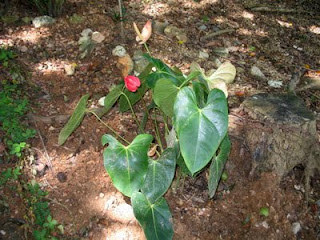


Among the plants was a Split Leaf Philodendron, some lovely Anthurium Andraeanums which produce a heart-shaped pink flower, some Dracaena Deremensis, and a plant I have yet to discover a name for as I was unable to read the writing on my invoice!

This is a photo of the unnamed plant which, I was told, will get bushy and possibly about 1-2 feet tall.

Planting on the island can be very, very time consuming and difficult. You see, where I live I have no water source other than a creek at the back of the property which, after your reach the 65' crest of the hill behind the house, you must walk down hill about 600 feet to reach the creek, which is at sea level. We use a pump to pump water up to three 55 gallon barrels along with a large 500 gallon tank we have in back of the house. This we use during the dry season to water plants. However, water pressure is slight (being gravity fed) and the hose does not reach to most of the plants in the front yard. Therefore, I must fill water cans (4-5 gallon ones) and walk all the water I wish to use down to the planting area when preparing to plant.

Also, the clay is very hard and holds the water for a long time. Most plants need loose soil to aerate the roots so I mix the clay with bit of sand. I then add fertilizer as the clay has almost nothing in it for feeding and producing a better plant.

Digging is another problem in that the clay is hard and their are many rocks embedded in the soil. This task I leave to my worker. I mean, after all, he must earn his pay! He generally likes to make a hole that a plant will just fit into and is never happy when I make him dig a much larger hole that I can fill it with looser soil to allow the roots to spread and pick up the nutrients easier. Also, it took years for me to train him that when you transplant plants they should 1) be well watered first, 2) fill the hole at least halfway with water before placing the plant in, 3) tap down the earth around the root ball thus eliminating any air pockets, and 4) water the plants to settle the dirt to again eliminate any air pockets. When he first started working for me, he would just pull up a plant not paying any attention to handling it carefully so that dirt remained on the roots, thrusting it into a small, dry hole, placing dirt around it and walking away. The theory was that eventually some plants might make it!

He has now seen that more plants live planting with my method, even though it requires work. I even get him to water plants when they are starting to droop as he always feels Nature should take care of that task without any help from him. Pulling weeds is something he puzzles at regarding the rationale behind this task. In his mind, they are just going to grow back!


When I plant, I also try to use driftwood, stone or some other type of natural product to produce an area pleasing to the eye. I am working on laying various pieces of driftwood on the gravel pathway from the dock to the base of the concrete walk leading to the house and, at the top of the walk, I have managed to mount a huge tree trunk and decorate it with plants and orchids.


All 20 plants were put in and I added some crotons that I had started from cuttings to the base of the sidewalk hoping for some color when coming off the gravel path. I want to plant some succulent plants in the sunny areas as fillers. I also have a lovely green ground cover which has small yellow flowers to fill in the "dirt" areas between the sidewalk and the new plants.


In my vast variety of plants I have purchased very few, only about 6 while building our home. Instead I was lucky to receive cuttings from friends. I have Aloe, Allamanda, Elephant Ear, Red and White Ginger, Pineapple, Bamboo, Bougainvillea, Rubber plant, Poinciana tree, Spanish flag, two types of wild Orchid, Australian Pine, Cactus, Lime tree, Autograph tree, Tamarond tree, various Hibiscus, Coconut palms, several varieties of Crotons,Ti plants, Dumbcane, Lobster claw, Heliconias, Spider Lily, Minature Ixora, Crepe Myrtle, Banana plants, Frangipani, Traveler's Palm, Moses-in-a-Cradle, Sugar cane, Mother-in-law's-tongue, Starfish flower, various un-named flowering plants used for boarders, Spider plants, Kalanchoe, Areca Palm, asparagus fern and other plants I have not identified here, all of which I planted while building our home. This is the first time I have made a major purchase of plants! So, all in all, I've been very lucky.

The next project will be in back of the house going up to the top of hill where we have cleared all the brush and excess trees and started planting last year. I had to wait until the rains returned and now is the time to get started. Busy months ahead!


Thursday, October 22, 2009

Northers Are Back!


In the fall and early winter, the island is subjugated to "Northers." These are cold fronts that come down from the north bringing with them cooler temperatures, rain and rough seas. We get several at this time of year; sometimes mild, sometimes quite fierce.

The Northers affect the West side of the island more as the seas come rolling in, crashing upon the beach and reshaping the seashore. People on that side of the island are pretty much prisoners of the sea during a Norther as one does not want to risk launching their boat. People bring their boats up to land or secure them in coves or anchor them out off their dock hoping the anchors will hold.


When the seas start coming out of the south on our side of the island (the East side), we can expect trouble, especially when the waves start building. We have had several Northers over the years here - the worst ones, of course, after hurricanes have passed.

We have a place to haul out one of our boats out of the water to avoid its destruction or damage to the dock. The larger boat is strapped to poles and is in partial suspension between the dock and the poles. Normally, when we know a storm is coming, we prepare the smaller boat, the skiff, by tethering it off one of the large dock posts with the back end held fast to the shore by a series of ropes tied to a tree. This is for mild storms. In more severe cases we must pull the boat up on shore, rolling it out on a series of posts laid out on the beach. Both of these precautions are time consuming and laborious.

Unfortunately, this past week a Norther approached which was stronger than expected. It appeared to be a mild storm and this early in the season my husband did not think it necessary to secure the boat and left them both tied to the dock. The first day was not bad but by the end of the second day, late into the afternoon, it was quite apparent that we had to get the boat tethered to the land by ropes attached to a tree. We did not have the luxury of pulling it up out of the way as the seas were too rough by now.

In hauling the boat around to the north side of the dock we discovered that one of the posts was weak and during our efforts, it broke off and part of the dock collapsed but not into the water, as the photo will show.


Also, during this time, while I was attempting to get the boat off one of the bumpers located next to the skiff, the boat slid off so I was left with one foot on the dock and the other on the boat! I decided it was not a good idea to fall between the boat and the dock, so I fell into the boat landing on my shoulder. Luckily I was not hurt, bruised maybe, but okay for the most part. The real problem was standing up in the boat which was now bucking like a wild stallion! It took several minutes to regain my feet and then a few more to time my jump from the boat to the dock, something I really do not want to do again!

With great effort we managed to get the boat around the end of the dock and tied the bow to the dock and its stern secured to the shore. The storm roared through the night and died down the next day. We awoke to sunny skies and calm waters.

My husband, our worker and me then proceeded to make repairs the dock. It is serviceable now after my husband spent much time in the water jacking up portions, nailing boards in place and securing what he could. We will definitely have to put in a new dock next year. This one lasted 11 years so we cannot complain. The creatures of the sea have eaten away at our support posts and it will be a small miracle if the dock can stand many more Northers that most certainly will be heading our way.

But, if one lives on the ocean one must put up with the small "inconveniences" to enjoy the beauty of it all!


Whales!

Besides the beauty of the ocean at our front door, we have wonders beneath the sea which, on rare occasions, present themselves for viewing.


It is well known that Whale Sharks swim off the waters of the Island of Utila. The Whale Shark is the world’s largest fish. The most common size seen in the waters around Utila is between approximately 6m and 10m (10 ft. and 33ft.), weighing around 15-20 tons.

Although more frequent in the months March-April and August-September, the Whale Shark is regularly sighted around the Island of Utila. Unlike dolphins or other fish which tend to school or travel in pods, Whale Sharks are solitary. However, it is not uncommon for 5 or more singular Whale Sharks to be sighted in a single day along the northern shores of Utila. It is thought that Utila to be home to an annual rendezvous of these presumably migratory creatures who have been recorded traveling 8,000 miles.

One possible reason for the congregation of these sharks around Utila is oceanography. Being located on the extreme northern margin of the Honduran shelf and unlike the other Bay Islands which are separated from the shelf area by a deep-fault controlled trench, the tropical island has shallow banks to the south and a very large bank to the north. Whale Sharks, however, have been sighted off the coast of Guanaja, but not with any regularity.

Just last week an extraordinarily rare occurrence took place in the water surrounding Guanaja. A pod of about 8 Pilot Whales was sighted off the shallower waters of Soldado Beach. The islanders were treated to an exceptional sight as these whales are generally found in deep water.

Long-finned pilot whales (Globicephala macrorhynchus) are one of the largest members of the dolphin family. The pilot whale, like the Killer Whale, is a member of the dolphin family, and is second only to the Killer Whale in size. Males can reach lengths of about 25 ft (7.6 m) and weigh as much as 5,000 lbs (2,300 kg), while females are generally smaller, reaching lengths of up to 19 ft (5.8 m) and weighing as much as 2,900 lbs (1,300 kg). They have a bulbous melon head with no discernable beak. Their dorsal fin is located far forward on the body and has a relatively long base. Their body color tends to be black or dark brown with a large gray saddle behind the dorsal fin. They are polygynous (males have more than one mate) and are often found in groups with a ratio of one mature male to about every eight mature females. Males generally leave their birth school, while females may remain in theirs for their entire lifetime.

They prefer warmer tropical and temperate waters and can be found at varying distances from shore but typically in deeper waters. Areas with a high density of squid are their primary foraging habitats. The short-finned pilot whales are found primarily in deep waters throughout tropical and subtropical areas of the world. There are four recognized stocks in the U.S.: West Coast, Hawaii, Northern Gulf of Mexico, and Western North Atlantic.

Partly because of their social nature, pilot whales are often involved in mass strandings. In this century, mass strandings of as many as several hundred pilot whales at one time have been recorded. Although no one knows why these beachings occur, some may result from persistence to keep the group together. Other reasons may involve mis-navigation when following prey, when traveling (possibly due to irregularities in the magnetic field), or possible parasitic infections resulting in neurological disorders.

We do not know why these beautiful creatures were so close to shore and a group of boaters spread out along the length of the shoreline attempting to stop the whales from beaching, if that is what they actually intended. I must assume the effort was a success as eventually all the boaters left to go home after taking the photos you can see them at - just cut and paste into your search engine:

http://www.facebook.com/inbox/readmessage.php?t=1049603695800#/album.php?aid=2019562&id=1317235539 .


Another creature seen off Guanaja is the Hammer Head Shark. Hammerheads are found worldwide in warmer waters along coastlines and continental shelves. There are nine known species of hammerhead ranging from 3 ft. to 30 feet in length. all the species have a projection on each side of the head that gives it a resemblance to a flattened hammer. The shark’s eyes and nostrils are at the tips of the extensions. I have had reports from friends who actually saw a Hammerhead from their boat but, to date, I have not glimpsed this creature.


I have experienced green moray eels up close and personal on several scuba dives off Southwest Cay and, thankfully, my husband was there with his camera to record the event.


The reefs of the Bay Islands are a treasure trove for photographers; lobster, cleaner shrimp, sea anemone, nurse shark, grouper, Angel fish, turtles, sting rays of several varieties, and the list goes on and on.


To look out on the water after a rain, on a calm day is to see the ever presence beauty that lies just below the surface and all the unexplored areas that are to be found is a delight. The colors of the water from deep blue to aquamarine to a greenish tint are a sight to behold and with the sun rising in the morning lighting the sky a dusty peach color, the spectacle is amazing.

Nature - ain’t she wonderful?